
History of tourism through words
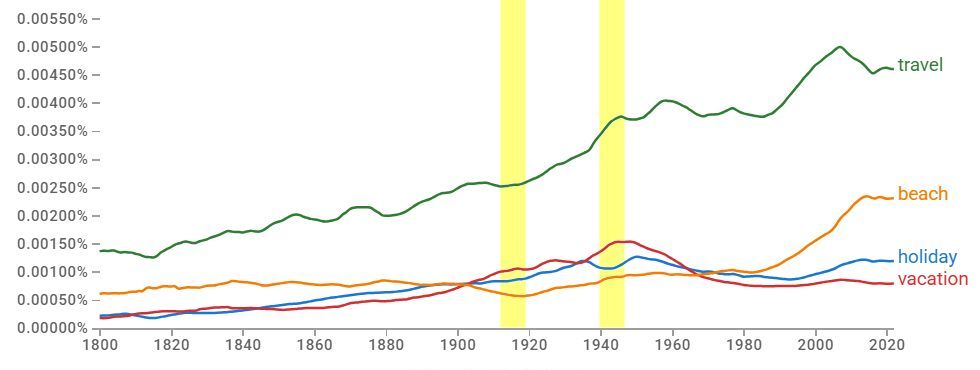
Checking out words predominantly used in travel and tourism reflect quite accurately when they become popular and when some of them declined in use. First, I checked travel+holiday+vacation going back to 1800 which showed an amazingly constant rise in popularity all the way through 1948. A trend undisturbed even by two world wars, then a plateau for travel, and a decline for both vacation and holiday from 1948 until about 1971. That's the generation that stayed home and had a lot more babies. In the same period the word education rose sharply to peak about 1971 and then a steady decline through today.
The baby boomers, born in that period, became the generation who favoured travel, beaches and tourism in general. From 1971, the words travel+beach shot up in popularity to a peak around 2010. The 2010 peak coincides with the beginning of the retirement age of the baby boomers.
The birth of tourism
The word tourism began to appear right after WWII, about 1946 and rose steadily through today. But looking only at the word is misleading as holiday travel, in its modern form, started in the mid 19th century in Europe with the birth of the railroad. Deauville, then a small fishing village in France, was transformed to become the first luxury resort town around 1860 with casino, horse racing and grand hotels. It was made possible by the half-day connection to Paris with the Train Bleu (the Blue Train) which was specifically a tourism train. At the same period, the new London & Brighton Railway made Brighton the first British resort town. In Switzerland, tourism exploded from the mid-19th century with a combination of Thomas Cook organized travel, the visit of Queen Victoria, British literature (Sherlock Holmes in Switzerland). The Golden Age of Alpinism was also mostly driven by British adventurers.
In North America, tourism came with the development of the railroad in the late 19th century, first with east coast destinations like Niagara Falls, then further west to Yellowstone. The dynamics were somewhat different than in Europe because of the geographic scale of North America. Any destination was more than a day's travel from any major city.
The golden years of tourism 1971-2003
The social shift from the sixties to the seventies is well documented, but nothing specific would define 1971 as the turning point of tourism ending a 25-year decline in popularity and the beginning of 30 golden years. Yet, the popularity of many of the keywords associated with tourism and leisure all took off around 1971. beach remained within a neutral range from 1900, then began a steady climb in popularity from the 1970s that lasted until about 2000. family vacation exhibited the same pattern between 1967 and 2003, cruise from 1972 to 2001, exotic vacation from 1975 to 2001 was not even a statistic before the 1950s. And so on.
That period does define the golden years of tourism with the great expansion of air travel and the emergence of tourism nations like Thailand, Italy and Spain. These were the years when one could say "build a hotel and they will come".
The rise and fall of travel agents
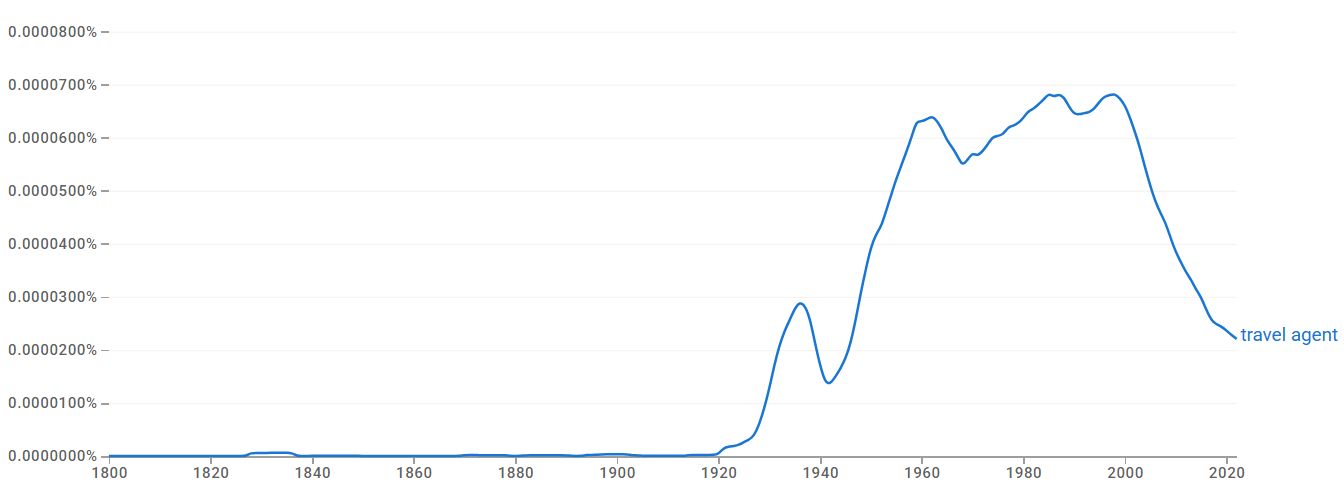
Checking the words travel agent is a fascinating example of the impact of the Internet on travel. Travel agent does not appear on nGram until 1920, then a steep rise until the 1960s (with a dip between 1938 and 1945). Travel agents became the inescapable middlemen between the consumers and the airlines and hotels. While they remind at their peak through the mid 1990s, their popularity ended with the emergence of the Internet in the mid 1990s, and perhaps significantly, the arrival of the first big search engine (Alta Vista) in 1996 coincides with the beginning of the long and steep decline of travel agent reflecting their diminishing role in the industry as consumers increasingly searched and booked their travel directly or through travel web sites. A confirmation of this trend can be seen by testing the words internet travel which rose steadily as travel agent faded away: consumers shifted their focus away from the middleman and directly toward the product itself.
Then everything changed
With the new century came the new travel and tourism model: rise of low cost airlines, birth of Airbnb, complete shift of travel planning and purchase. And increasing travel distances with, for example in Europe, before the turn of the century, the beach destinations were Italy and Spain, they are now Thailand, the Caribbean, the Maldives. The hot spots were low to mid range all-inclusive resorts like ClubMed. Today ClubMed is all in the premium, exclusive upper market having abandoned their iconic model of "Gentils Membres" given beads to exchange for drinks. It is now a point system like airline loyalty programs.
Pricing is now dynamic. It started with air tickets, then hotels started to use the model. Now even attractions are doing it. Just one generation ago, only airline tickets were paid long before travel, hotel bookings only required a deposit to the agent, which often was the same amount as their sales commission. Then it was cash on site with money exchange booths everywhere. Today, both air tickets and hotels are typically prepaid, and most of the spending on site is through bank cards. Cash exchange booths are still around, but the amounts changed to cash are a magnitude smaller.
The social dimension of tourism has also changed. Instagram has replaced postcards. Influencers have replaced travelling storytellers. Diversity and discovery replaced the annual vacation at the same place and same month to be with the same vacation friends every year.